


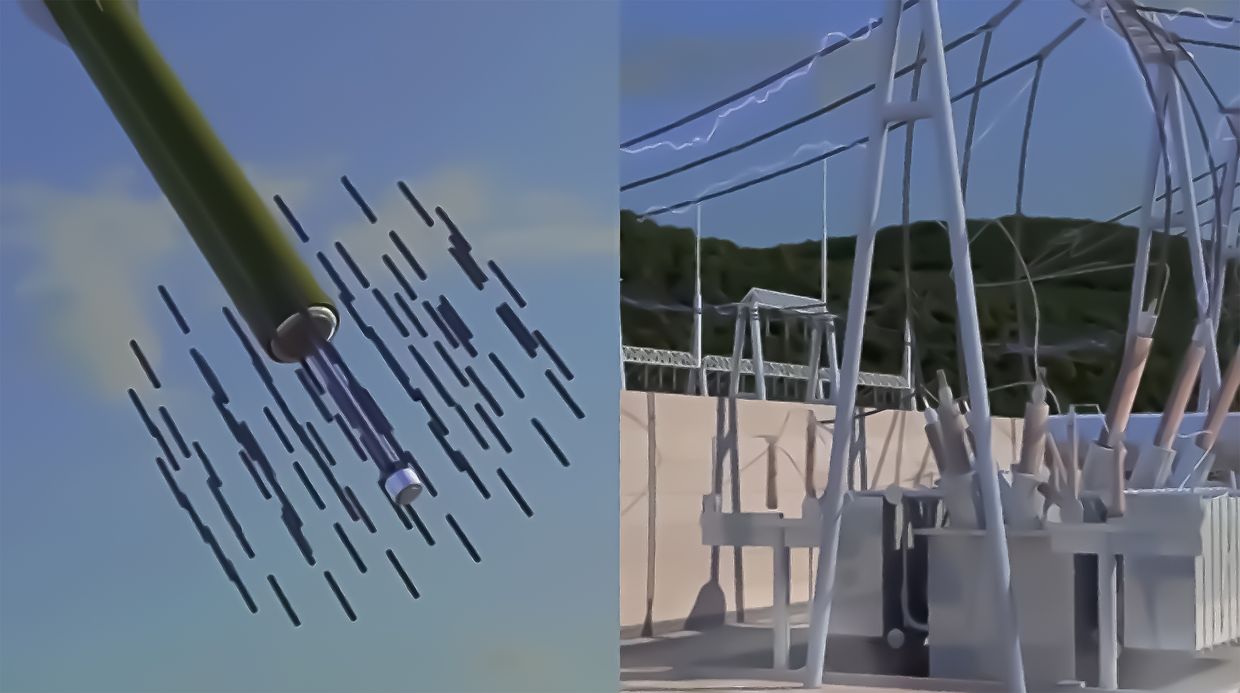
A screengrab from China’s state TV broadcaster that showcased details of a new “graphite bomb.” (South China Morning Post)
Introduction to China’s Graphite Bomb
China’s state television has announced the development of a new weapon known as the “graphite bomb,” capable of completely disrupting electricity across a 10,000 square meter area or incapacitating entire power stations. This revelation was reported by the South China Morning Post on June 29.
What is a Graphite Bomb?
Graphite bombs, also referred to as “blackout bombs,” function by dispersing dense clouds of tiny graphite particles over a defined target area. Because graphite is an excellent conductor of electricity, this can result in short-circuiting power lines and electrical equipment. The aftermath would see all electrical devices in the vicinity rendered nonfunctional, significantly impacting both civilian and military operations.
Mechanism of Action
In a demonstration video aired by China’s CCTV, the graphite bomb is depicted being launched from ground-based systems. Upon reaching its target, it releases 90 submunitions that bounce off the ground before detonating and spreading a cloud of graphite particles. This sequence was illustratively shown disrupting electrical equipment within a mock electrical substation, emphasizing the weapon’s intended targets.
Historical Context of Graphite Bombs
Graphite bombs are not new; they have been in existence for decades and have been employed by Western nations. NATO used them in 1999 during the Kosovo War to incapacitate power plants in Serbia, leading to widespread power outages affecting approximately 70% of the country. While the goal was to minimize civilian casualties, the collateral damage included severe disruptions in hospitals and public services.
Impact of Graphite Bombs on Civilian Life
Though classified as non-lethal, the consequences of deploying graphite bombs can lead to critical civilian challenges, as widespread power outages can jeopardize public health and safety. A report by the International Physicians for the Prevention of Nuclear War highlighted that targeting civilian infrastructures, such as power plants and hospitals, creates significant public health risks and potentially endangers lives.
Comparing U.S. and Chinese Graphite Bomb Technologies
While details surrounding China’s graphite bomb remain limited, there are observable differences from similar U.S. technologies like the BLU-114/B. The U.S. version disperses carbon-fiber wire spools, which can vaporize upon contact with high voltages, while the Chinese model appears to use submunitions that self-detonate for graphite particle dispersal. This difference could influence the bomb’s deployment strategies and overall effectiveness.
Global Perspective on Graphite Bombs
In addition to China and the U.S., other nations have also developed graphite bomb technologies. For instance, South Korea announced in 2017 that it had created its own version of a graphite bomb, ready for potential use against North Korea in the event of conflict. As global tensions rise, the implications of these weapons on international relations and civilian safety remain a pressing concern.
Thank you for engaging with this article. The Kyiv Independent operates without a paywall, relying on readers to support our journalism. If you found this information valuable, consider joining our community today.
China Unveils New Graphite Bomb Capable of Widespread Blackouts
China’s state television reported on a revolutionary weapon called a “graphite bomb,” designed to disrupt electrical grids over a vast area. This new bomb claims the ability to incapacitate power stations and render electricity unavailable across 10,000 square meters, significantly impacting civilian and military infrastructure.
Animation Showcases Power Disruption
The unveiling included an animated demonstration from CCTV, depicting a missile launch that delivers 90 small submunitions. Upon reaching its target, these submunitions scatter across the ground, resulting in explosions within a simulated electrical substation, leading to evident malfunctions of electrical systems.
Heightened Tensions and Strategic Implications
The introduction of the graphite bomb arrives during a period of escalating global tensions, particularly concerning China’s posture toward Taiwan. Furthermore, China’s alliance with Russia has deepened, contributing to efforts to counter Western sanctions and supplying dual-use goods critical to the Russian defense sector.
Understanding Graphite Bomb Technology
Graphite bombs, often referred to as “soft bombs” or “blackout bombs,” deploy a dense cloud of graphite particles across targeted areas. Due to graphite’s effective conductivity, this cloud can short-circuit electrical systems, rendering all associated devices nonfunctional. If deployed over power stations, the consequences can extend to entire regions, causing significant power outages.
Historical Context of Graphite Bomb Utilization
This type of weapon is not entirely new; Western nations have utilized graphite bombs in past conflicts. Notably, during the Kosovo War in 1999, NATO targeted Serbian power plants, resulting in widespread blackouts impacting hospitals and public services. A follow-up report highlighted the adverse effects of attacking civilian infrastructure on public health and safety.
Differences in Deployment Mechanisms
While specific details regarding China’s graphite bomb functionality remain limited, it appears to differ from the U.S. version. The American BLU-114/B model disperses carbon-fiber wire, which vaporizes upon contact with high voltage. In contrast, China’s bomb employs submunitions that self-detonate to produce graphite particles.
Global Perspectives on Graphite Bomb Development
South Korea has asserted its capability to deploy graphite bombs, aimed at neutralizing threats from North Korea. The evolving technology surrounding such weapons underscores the continuing geopolitical maneuvering and military strategies that characterize current international relations.
This innovative weaponization of graphite serves as a stark reminder of the complexities within modern warfare and the implications of targeting vital infrastructure. As nations explore new strategies and technologies, the potential for unprecedented disruption in civilian and military spheres becomes increasingly real.
