


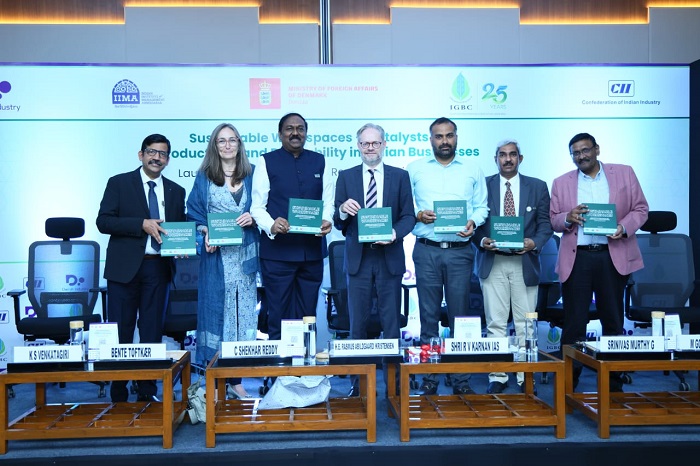
The Confederation of Indian Industry (CII), alongside the Indian Green Building Council (IGBC), has partnered with the Confederation of Danish Industry (DI) to unveil a groundbreaking research report titled “SUSTAINABLE WORKSPACE – Catalyst for Productivity and Profitability in Indian Businesses”. The launch took place at the CII Green Business Centre in Hyderabad.
This unique research study, bolstered by academic support from the Indian Institute of Management Ahmedabad, highlights the transformative impact of sustainable workplaces on Indian businesses. The findings indicate that organizations embracing Green Building Practices are more likely to develop a thriving and engaged workforce, leading to enhanced business performance.
Going beyond mere environmental responsibility, the study illustrates that integrating green building strategies can significantly improve employee productivity, well-being, and organizational profitability. This multi-year project presents compelling evidence that green solutions in India’s workplaces lead to substantial enhancements in employee engagement and overall well-being.
Key Findings from the Research
The research presents crucial insights, including:
- A 1% increase in Green Index, which encompasses indoor environment quality and comfort, results in a 3% boost in employee thriving and a 2% increase in engagement.
- A 1% improvement in Indoor Environment Quality can elevate employee engagement by 7% and thriving by 2%.
- Enhanced Indoor Environmental Quality (IEQ)—addressing factors such as temperature, lighting, noise, humidity, and CO₂ levels—can uplift psychological vitality and learning in the workplace, ultimately driving innovation and staff retention.
These findings validate the notion that sustainable workspaces yield far-reaching benefits, including higher employee satisfaction, well-being, and profitability, regardless of the climate or culture in India.
Inauguration Ceremony
The report was officially introduced by esteemed dignitaries, including H.E. Rasmus Abildgaard Kristensen, Ambassador of the Royal Danish Embassy to India; Shri R V Karnan IAS, Commissioner GHMC Government of Telangana; and Mr. C Shekar Reddy, National Vice Chairman, IGBC, among others. Their presence underscored the collaborative spirit in fostering sustainable development.
Statements from Key Leaders
During the launch, H.E. Mr. Rasmus Abildgaard Kristensen expressed Denmark’s commitment to partnering with India in fostering sustainable, people-centric development. He emphasized that collaboration can lead to transformative solutions, enhancing well-being and productivity while mitigating environmental impact.
Shri R V Karnan IAS lauded Telangana’s efforts in leading India’s sustainable building evolution, showcasing Hyderabad as a burgeoning hub for green buildings. He affirmed the state’s dedication to implementing IGBC-certified projects that prioritize energy efficiency and eco-friendly practices.
Implications for Business Leaders and Policymakers
According to Mr. C Shekar Reddy, the launch of this report signifies a pivotal moment as IGBC celebrates 25 years in the green building movement. He urged stakeholders to focus on enhancing workplace conditions that foster creativity, well-being, and productivity while maintaining environmental integrity.
Actionable Insights for Stakeholders
The report offers actionable recommendations for business leaders, developers, policymakers, urban planners, architects, and ESG investors. Key suggestions include:
- Prioritizing Indoor Environmental Quality and comfort in both new and existing workplaces.
- Integrating measurable green metrics into design and operational frameworks.
- Utilizing evidence-based tools to evaluate workspaces, thereby driving employee engagement and organizational success.
By aligning with these recommendations, organizations can not only contribute to a greener planet but also achieve sustainable business growth and resilience in the future.
Sustainable Workspaces: A Catalyst for Productivity and Profitability
The Confederation of Indian Industry (CII) and the Indian Green Building Council (IGBC), in partnership with the Confederation of Danish Industry (DI), recently unveiled groundbreaking research entitled “SUSTAINABLE WORKSPACE – Catalyst for Productivity and Profitability in Indian Businesses.” This report was launched at the CII Green Business Centre in Hyderabad and highlights the pivotal role of sustainable workplaces in transforming business performance across India.
Key Insights from the Research
This pioneering study, conducted with academic backing from the Indian Institute of Management Ahmedabad, suggests that businesses embracing green building practices experience significant benefits. Organizations that prioritize sustainable work environments not only improve employee engagement but also enhance overall business performance. The research underscores that environmental responsibility transcends mere compliance, driving productivity, well-being, and profitability.
Data-Driven Findings
Employing a comprehensive methodology, this multi-year project examined inputs from 75 case study partners and captured over 1,100 responses from occupants across six cities. Additionally, the analysis included more than 900 data points on indoor environmental quality. The findings provide compelling evidence that adopting sustainable building practices significantly boosts employee well-being and organizational efficiency.
Understanding Indoor Environmental Quality (IEQ)
The research emphasizes the importance of Indoor Environmental Quality (IEQ), which encompasses factors like temperature, lighting, noise, humidity, and CO₂ levels. An increase in IEQ leads to heightened psychological vitality and learning at work, ultimately translating into improved staff retention and innovation. Specifically, a 1% rise in IEQ correlates with a 7% increase in employee engagement and a 3% boost in overall well-being.
Implications for Business Leaders
Key findings indicate that even a minor 1% increase in the Green Index can elevate employee thriving by 3% and engagement by 2%. This data reinforces the notion that creating sustainable workspaces is not merely an ethical consideration but a strategic advantage. The research concludes that sustainable work environments yield considerable long-term benefits, improving both employee satisfaction and organizational profitability across diverse climatic and cultural settings in India.
Stakeholder Reactions
During the report launch, dignitaries emphasized the critical connection between sustainability and economic growth. The Ambassador of Denmark and other officials highlighted the collaborative efforts to foster green transitions in urban setups. They reiterated the need for innovative solutions that not only mitigate environmental harm but also enhance employee creativity and productivity.
Actionable Recommendations
The report offers actionable insights for a variety of stakeholders, including business leaders, developers, policymakers, urban planners, and industry associations. Recommendations range from prioritizing IEQ in all workplaces to integrating measurable green metrics in workplace design and operations. By assessing workspaces with evidence-based tools, organizations can significantly drive employee engagement and overall success.
In summary, the research on sustainable workspaces presents a strong case for businesses to invest in environmentally friendly practices that yield mutual benefits for employees and organizations. By fostering an environment that enhances well-being, companies can create a resilient workforce and drive profitability in the long run.
