


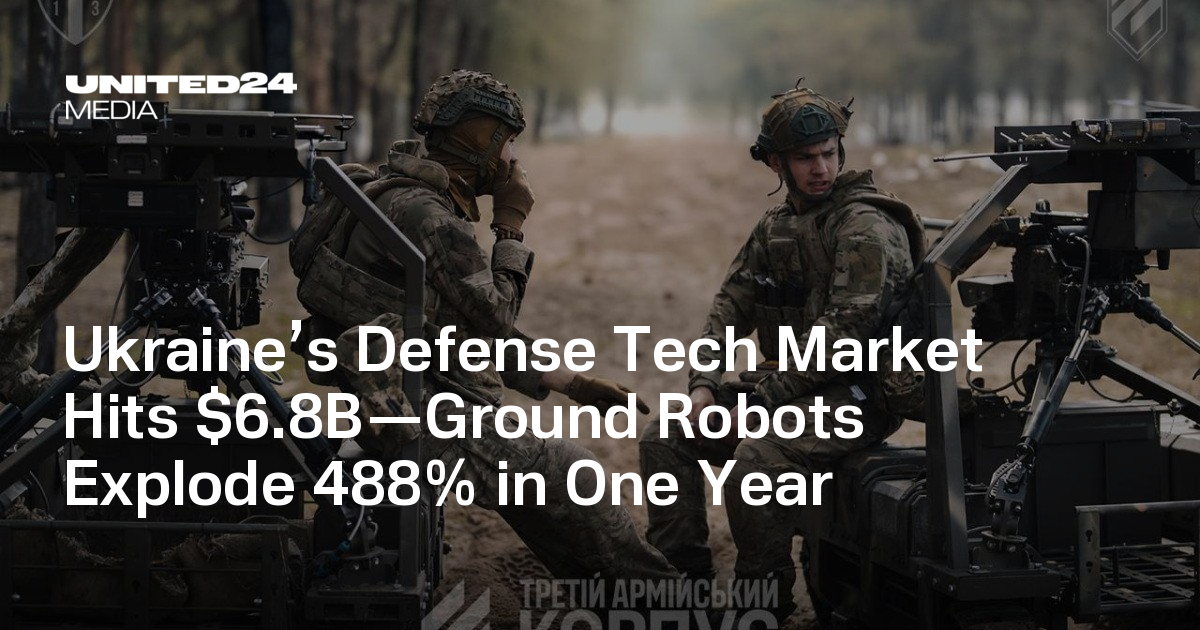
Ukraine’s defense technology sector is projected to grow to an estimated $6.8 billion by 2025, showcasing remarkable advancements, particularly in ground robotic systems. This segment saw an impressive production increase of 488% over the past year.
According to a joint study conducted by the Kyiv School of Economics (KSE) Institute, Brave1, and Defence Builder, released on April 2, the growth within the defense sector has not been uniform. While traditional defense manufacturing has lagged due to limited domestic funding, high-tech segments, particularly in robotics and UAV technology, are experiencing rapid acceleration.
Growth in Unmanned Aerial Vehicles
The KSE Institute points out that the production of unmanned aerial vehicles (UAVs) has surged by 137% in 2025. Moreover, electronic warfare systems have reported an extraordinary growth rate of 215%. Ground robotic systems, often referred to as unmanned ground vehicles, have achieved an astonishing near-sixfold increase, bringing their market size to approximately $252 million.
Real Market Size Potential
The study suggests that the actual size of Ukraine’s defense tech market could be significantly larger than official statistics indicate. A notable portion of military procurement occurs through decentralized channels, including charitable foundations, direct contracts at the unit level, and in-house production by military brigades, which are often not captured in national data.
UAV Sector Dominance
Among the various market segments, the UAV category remains the largest and most developed, boasting an approximate market value of $6.3 billion. Within this sector, both long-range drones and interceptor drones are rapidly scaling, while First-Person View (FPV) systems continue to dominate in terms of production volume.
Emerging Developments in Defense Technology
New opportunities are arising within the Ukrainian defense landscape, particularly in the development of interceptor drones, mid-strike platforms, and domestically produced reconnaissance multicopters designed as alternatives to established systems like China’s DJI drones.
Investment Landscape Transformation
In 2025, Ukrainian defense companies and startups secured at least $129 million in investments and grants, predominantly directed towards the areas of artificial intelligence and software development. Key financial sources include Brave1 grants, venture capital, and state-backed lending programs like the “5–7–9%,” alongside direct procurement by allied nations.
Continued International Interest
The findings of the study also reveal a growing international interest in Ukraine’s defense technology sector, bolstered by new cooperation frameworks and funding initiatives. Recently, the European Commission launched a €1.5 billion program aimed at enhancing the defense industrial base of the EU and Ukraine, signaling a trend towards integrating Ukrainian technologies into wider Western defense systems.
Ukraine’s Defense Technology Sector Thrives Amidst Innovation
In 2025, Ukraine’s defense technology sector is projected to reach an impressive estimated value of $6.8 billion, marking significant growth driven primarily by advancements in ground robotic systems. The production of these systems has witnessed a staggering 488% increase within just one year, illustrating the rapid evolution of the industry.
Key Growth Areas in Defense Technology
A comprehensive study conducted by the Kyiv School of Economics (KSE) Institute, Brave1, and Defence Builder highlights uneven growth within the sector. While traditional defense production has experienced slower growth due to limited domestic funding, high-tech segments are flourishing. Notably, unmanned aerial vehicles (UAVs) have seen a remarkable 137% increase in production, while electronic warfare systems have surged by 215%.
Unmanned Ground Vehicles on the Rise
The most notable rise has been in ground robotic systems, also known as unmanned ground vehicles, which have expanded nearly sixfold, reaching an estimated market size of $252 million. This growth indicates a strong demand for automation and robotics within military operations, enhancing battlefield efficiency and effectiveness.
Challenges in Measuring Market Size
The actual size of Ukraine’s defense tech market could be even larger than reported, as much of the procurement occurs through decentralized channels such as charitable foundations and direct contracts at the unit level. This decentralized nature means that national statistics may not fully capture the thriving marketplace.
Emerging Trends and Innovations
The KSE Institute’s research outlines that the UAV segment is the most developed in the market, estimated at around $6.3 billion. This sector is rapidly evolving, especially in long-range and interceptor drones, as well as first-person view (FPV) systems, showcasing a versatility crucial for modern military operations. New innovations in interceptor drones and domestically produced reconnaissance multicopters are giving rise to competitive alternatives against established foreign products.
Investment and Development Insights
In the previous year, Ukrainian defense firms attracted over $129 million in investments, primarily focused on artificial intelligence and software development. Key funding sources include Brave1 grants and state-backed lending programs, revealing robust interest from international investors eager to support the innovative landscape.
International Collaboration and Future Prospects
The findings suggest an increasing global interest in Ukraine’s defense technologies, further emphasized by new collaboration frameworks. The European Commission’s recent approval of a €1.5 billion initiative aims to bolster the defense industrial capabilities of both the EU and Ukraine, showcasing a clear path towards greater integration of Ukrainian technologies within Western defense strategies.
As the Ukrainian defense technology sector continues to evolve amidst ongoing challenges, it is poised to become a critical player in the global defense landscape, fueled by innovation, collaboration, and an entrepreneurial spirit.
This structure includes appropriate headings, informative content, and relevant keywords to enhance SEO, while maintaining engaging flow throughout the article.
