


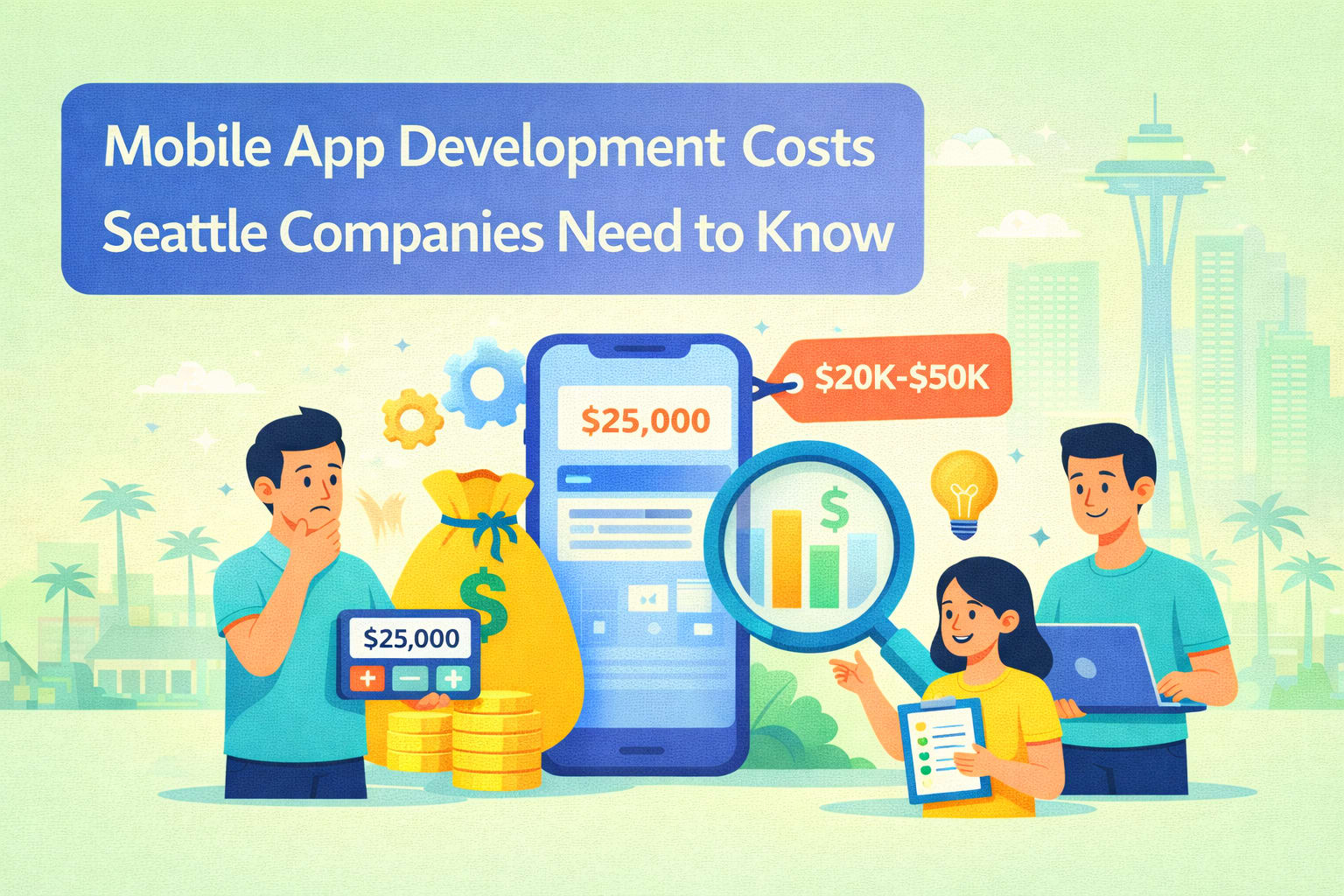
In a serene conference room or at a kitchen table turned workspace, a business leader in Seattle meticulously examines a project proposal, grappling with inner conflict. The figures are sound on paper, yet something feels amiss. Experience has shown them that software costs often extend beyond the initial invoice.
In Seattle, this instinct is typically correct. Conversations around mobile app development frequently falter not due to high prices, but rather because financial implications have been misunderstood.
Understanding the Higher Initial Costs of Seattle App Development
Seattle is not known for being a budget-friendly market, and it embraces this reality. Data from Statista indicates that software development wages in the Pacific Northwest rank among the highest in the nation, propelled by fierce competition for senior engineers alongside stringent reliability expectations.
Operating in a technology-heavy backdrop, Seattle firms contend with security-conscious customers and rapidly evolving platforms. Local development teams are more likely to account for risks upfront, resulting in higher initial quotes but fostering stability in the long run.
The Financial Landscape Beyond Initial Build Costs
Many organizations regard mobile apps as capital projects that require a one-time build followed by minimal maintenance. However, software functions differently. Statista reports nearly 60% of total mobile app expenditures occur post-launch, covering updates, platform compatibility, and security patches.
This post-launch phase bears even greater significance in Seattle, where swift operating system updates and cloud-based service changes can leave unmaintained apps vulnerable to issues more rapidly than in other regions.
Divergent Quotes: What Lies Beneath Price Variations
Seattle companies often express confusion when confronted with proposals that vary dramatically—sometimes by hundreds of thousands of dollars—despite addressing similar project scopes. The crux of the difference usually lies in underlying assumptions between the estimates.
For instance, one proposal may focus on limited testing and shallow documentation, while another might encompass comprehensive oversight, sustained support, and rigorous performance evaluations under real-world conditions.
The Cost Efficiency of Senior-Level Decision-Making
While senior engineers may command high fees, the expenses associated with rework are typically steeper. Research by Gartner reveals that most app failures after launch can be traced back to fundamental architectural choices rather than mere coding errors.
Teams in Seattle that prioritize informed, senior decision-making at the outset often sidestep costly rebuilds later. Although this strategy may seem slower at first, it tends to yield significant long-term savings.
The Long-Term Costs of Feature Expansion
Seattle businesses frequently begin app projects with humble objectives, only to see a gradual accumulation of features that seems reasonable at the time. Each feature adds complexity, and Gartner’s findings indicate that apps that undergo frequent enhancements face disproportionately higher maintenance costs when not architected for flexibility.
Local developers often advise a restrained approach: focus on fewer features for better long-term support. In the realm of mobile app development, this strategy is more financial prudence than mere design preference.
The Hidden Costs of User Experience and Performance
When an app exhibits sluggishness or confusing interfaces, users tend to withdraw silently. Statista reveals that performance issues lead to quicker user abandonment than, for example, outdated aesthetics.
Rectifying such issues post-launch often necessitates extensive backend optimizations, UX modifications, and additional testing—costs that are frequently omitted from initial budget estimates unless clearly detailed from the start.
Security Costs: An Investment in Resilience
While security may not elicit excitement, it serves as a pillar of resilience. According to IBM, the average cost of a data breach exceeds $4 million, with software vulnerabilities being a significant contributor.
In Seattle’s compliance-driven landscape, especially within sectors like healthcare, fintech, and logistics, proactive security planning can elevate upfront costs but dramatically mitigate risk.
Conclusion: Embracing Predictability Over Initial Savings
For Seattle businesses, surprise costs often inflict more pain than extended timelines. A predictable budget fosters planning, while unexpected expenses disrupt operational flow. Mobile app development choices increasingly lean towards stability over speed, as well-constructed apps contribute to business growth with fewer distractions.
In 2026, navigating mobile app development in Seattle will focus less on identifying the lowest bid and more on grasping the full financial implications. Ultimately, the app that triumphs is seldom the cheapest option—it’s the solution that allows businesses to flourish without encountering roadblocks.
Understanding Mobile App Development Costs in Seattle
Mobile app development in Seattle can often lead to unexpected expenses for businesses. While initial proposals may look appealing, the reality is that long-term financial commitments can outweigh those upfront savings. Companies in Seattle must recognize not just the build costs, but also the myriad expenses that come after launch.
Why Initial Costs Can Be Misleading
Seattle is not a budget-friendly market for mobile app development. The region boasts some of the highest software development wages in the U.S., primarily due to fierce competition for talent. This reality means that while some initial quotes may seem high, they often include risk assessments that mitigate future challenges.
The Importance of Post-Launch Costs
Many businesses mistakenly treat mobile app development like a one-time capital project. However, studies indicate that nearly 60% of total spending occurs after the app’s launch. This includes essential updates, compatibility checks, and necessary security enhancements—a crucial consideration given Seattle’s fast-evolving tech landscape.
Factors Behind Price Variation in Proposals
When seeking app development proposals, companies often encounter significant cost discrepancies. These differences usually stem from various underlying assumptions. Some quotes may reflect minimal support or testing, while others include comprehensive oversight and a focus on future maintenance. Understanding these variables can be key to making an informed choice.
The Role of Senior Engineering Expertise
While it’s true that hiring experienced engineers can drive up initial costs, the price of rework can be exponentially higher. Data shows that many post-launch app failures can be traced back to poor initial architectural decisions. Investing in skilled engineers at the beginning stages often leads to more stable applications in the long term.
Mitigating Long-Term Costs with Strategic Feature Planning
In Seattle, the temptation to continuously add features to an app can complicate ongoing maintenance significantly. Each new feature feels justified at the moment, but excessive complexity can lead to skyrocketing maintenance costs. To keep expenses manageable, development teams often recommend maintaining a simple, focused feature set.
Prioritizing User Experience and Performance
App performance directly impacts user satisfaction and retention. Users quickly abandon apps that frustrate them with slow loading times or confusing interfaces. Addressing these issues post-launch requires substantial backend adjustments and user experience enhancements, often neglected in the initial budgeting phase.
Emphasizing Security to Prevent Hidden Costs
While security measures may not be the most exciting aspect of app development, they’re crucial for long-term success. The cost of a data breach can reach millions, underscoring the importance of embedding security measures right from the start. Companies in Seattle, especially in sectors like healthcare and finance, must prioritize compliance to protect against these potential costs.
Questions to Consider Before Committing to a Budget
Before finalizing budgets, businesses should ask specific questions about ongoing costs, support structures, and change request pricing to avoid hidden fees after launch. Establishing clear ownership models post-launch can greatly enhance budget accuracy and reduce conflicts.
The True Cost of Mobile App Development
Ultimately, the cost of mobile app development in Seattle is multifaceted—encompassing not just the initial build but also ongoing maintenance, updates, and security considerations. Companies that elucidate these layers will be better positioned to make informed decisions, ensuring their apps not only launch successfully but also thrive over time.
