


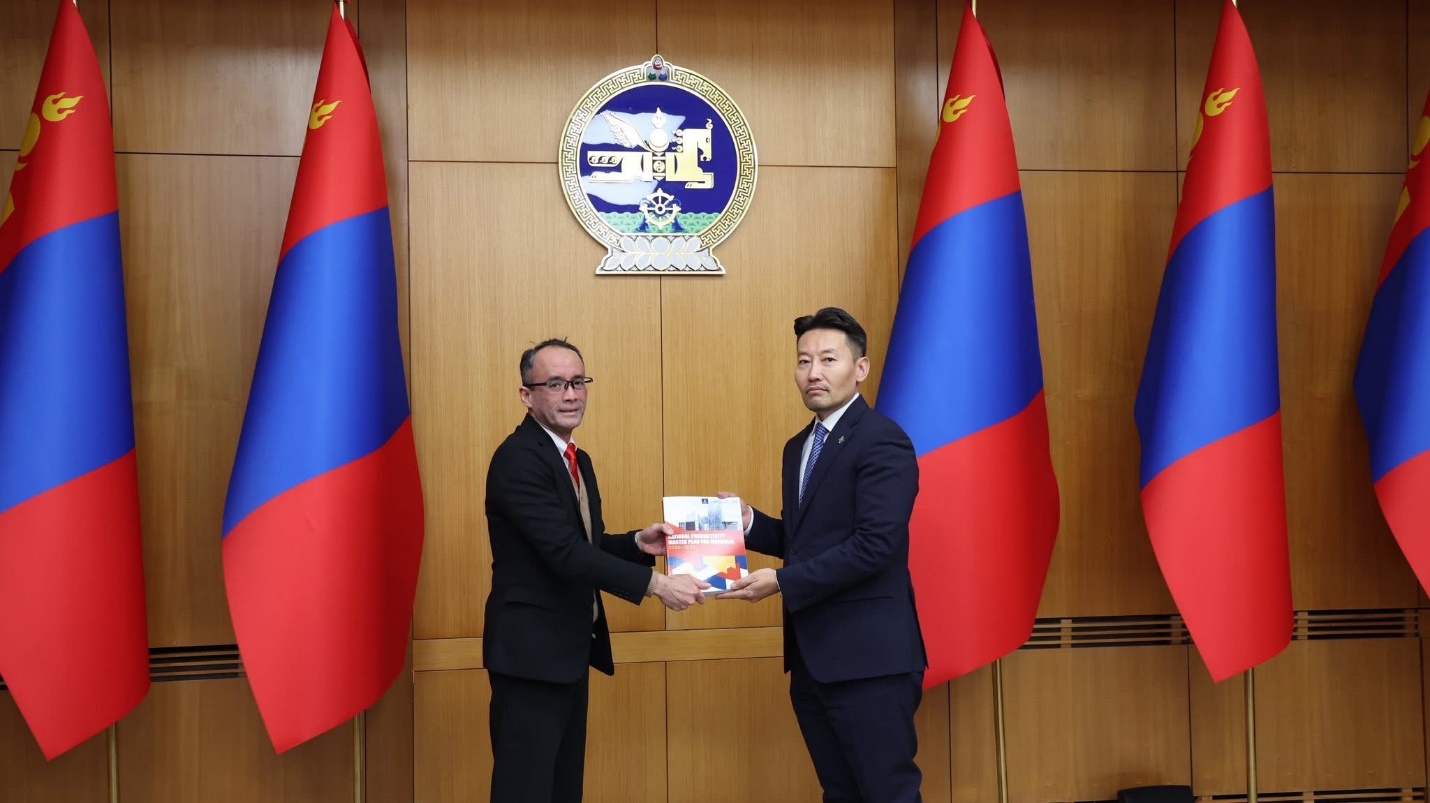
ULAANBAATAR, Mongolia, Jan. 27, 2026 — The Government of Mongolia has officially received the National Productivity Master Plan for Mongolia 2026–2035. The handover took place at the Deputy Prime Minister’s office in the Government Palace, Ulaanbaatar, on January 26, 2026. This significant moment was marked by a formal ceremony where the master plan was handed to Deputy Prime Minister H.E. Gankhuyag Khassuuri by APO Secretary-General Dr. Indra Pradana Singawinata. The event was jointly organized by the Ministry of Family, Labour and Social Protection, the Mongolian Productivity Organization, and the Asian Productivity Organization (APO).
Strategic Vision for Economic Growth
The National Productivity Master Plan aims to provide a comprehensive framework for enhancing competitiveness and resilience in Mongolia. By prioritizing productivity as a measurable goal, the plan articulates a clear message: If significant reforms are not undertaken, Mongolia’s GDP growth is expected to decline from an average of 6.2% during 2000–2024 to 4.2% from 2026–2035, and further down to 2.8% from 2036 to 2050. This troubling trend is primarily driven by a predicted decrease in labor productivity contributions, which could fall from 4.0% to 1.4% in the same timeframe.
A New Era of Productivity
Dr. Indra expressed that “The Master Plan is not merely a report. It is a strategic instrument of statecraft.” He emphasized that positioning productivity as a national priority can simultaneously elevate living standards, boost competitiveness, and expand opportunities for citizens.
Commitment from the Mongolian Government
In his address, Deputy Prime Minister Gankhuyag reaffirmed the Government’s commitment to a productivity-led development model. This includes initiatives aimed at increasing the labor productivity and wages of the Mongolian workforce, alongside efforts to maintain stable growth exceeding 6% through enhanced manufacturing processes and diversification. He noted that public sector reforms under the New Revival Policy will focus on digitizing services, reducing red tape, and improving service quality.
Focus on Labor Productivity
Minister for Family, Labour and Social Protection Aubakir Telukhan highlighted the overarching goal of initiating a “Productivity Revolution.” He emphasized efforts to reduce unemployment and improve labor productivity and wages in alignment with rapid technological changes, shifts in trade, and adaptive climate policies. Notably, he pointed out that average labor productivity in Mongolia stands at $11,300, which is 3.6 times lower than the global average.
Five Strategic Thrusts for Implementation
The master plan outlines five strategic thrusts designed to accelerate productivity in Mongolia:
- Expanding market access and prospects
- Driving technology and digitalization
- Enhancing the quantity and quality of talent
- Creating an efficient business environment
- Fostering inclusiveness and equity
Priority Sectors for Growth
Additionally, the plan specifies eight priority sectors for targeted productivity enhancements, including agriculture, forestry and fishing, processing industries, wholesale trade, education services, accommodation and food services, health services, waste management, and transportation. This multi-sector approach reflects a holistic understanding of Mongolia’s economic landscape and growth potential.
APO’s Ongoing Support
Dr. Indra expressed gratitude to the Government of Mongolia, the Mongolian Productivity Organization, and all involved stakeholders for their leadership and contributions. He reiterated the APO’s commitment to supporting the effective implementation of Mongolia’s National Productivity Master Plan to achieve tangible outcomes that benefit the country.
The Role of the Asian Productivity Organization
The Asian Productivity Organization (APO) is a regional intergovernmental entity focused on enhancing productivity across the Asia-Pacific region through collaborations among its members. Established in 1961, the APO now includes 21 member economies, providing essential support, national policy advisory services, and institutional capacity-building initiatives aimed at stimulating economic development through increased productivity.
For further inquiries, contact the APO Digital Information Unit at pr@apo-tokyo.org. More information can be found on the APO website.
Mongolia Launches National Productivity Master Plan for 2026-2035
In a significant move towards enhancing economic growth, Mongolia has officially launched its National Productivity Master Plan for 2026-2035. The ceremony, held on January 26, 2026, at the Deputy Prime Minister’s office in Ulaanbaatar, marks a pivotal step in fostering national competitiveness and productivity initiatives.
Objectives of the National Productivity Plan
This master plan aims to create a strategic framework for enhancing productivity, emphasizing its critical role in driving economic resilience. It assesses the current productivity landscape in Mongolia and sets ambitious goals for measurable improvements in GDP growth.
Projected Economic Impacts
If Mongolia follows the current trend without implementing key productivity reforms, annual GDP growth could decline from 6.2% (2000-2024) to 4.2% in 2026-2035, eventually dropping to 2.8% from 2036 to 2050. This forecast emphasizes the necessity for structural changes, particularly in labor productivity.
Strategic Framework for Productivity Improvement
The master plan outlines five strategic thrusts: expanding market access, driving technology and digitalization, enhancing talent quality, creating an efficient business environment, and promoting inclusiveness and equity. These areas are designed to collectively boost the nation’s productivity levels.
Priority Sectors for Focused Growth
Additionally, the master plan identifies eight key sectors ripe for productivity enhancement, including agriculture, manufacturing, education services, and transportation. By prioritizing these sectors, Mongolia aims to significantly uplift its economic capabilities over the next decade.
Government’s Commitment to Productivity
As articulated by Deputy Prime Minister Gankhuyag, the government is committed to elevating labor productivity and wages, aiming for sustainable growth rates above 6%. This commitment entails comprehensive public sector reforms, encompassing digital transformation and reduced bureaucratic hurdles to ensure improved service quality for citizens.
Collaboration and Support from the Asian Productivity Organization
The Asian Productivity Organization (APO) played a crucial role in formulating this master plan, with Secretary-General Dr. Indra Pradana Singawinata expressing gratitude to the Mongolian government for its collaborative spirit. The APO will continue to provide support to ensure the effective implementation of the master plan and achievable outcomes.
Conclusion: A Vision for the Future
As Mongolia embarks on this ambitious productivity journey, the focus on economic reform and development positions the nation for a more competitive future. The National Productivity Master Plan serves not only as a roadmap for economic growth but also as a catalyst for enhancing the quality of life for all Mongolian citizens.
